



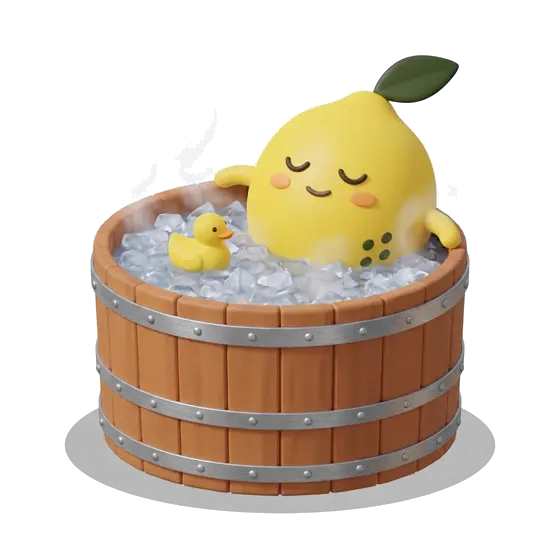
What is an ice bath?
An ice bath, also called a cold plunge, means sitting in very cold water, usually up to your chest or shoulders, for a few minutes. At Peaceful Day it’s a wooden tub of crushed ice and water, with the team guiding your breathing.
What does the research support?
Less muscle soreness after exercise
A Cochrane review of 17 small trials found that sitting in cold water after exercise reduced muscle soreness over the next few days, compared with simply resting. The trials were small and their quality was mixed.
Feeling more alert
In a 2000 study, people who sat in water at 14°C for an hour had much higher levels of noradrenaline and dopamine in their blood, chemicals linked to alertness and mood. A 2023 study found that five minutes in cold water left volunteers feeling more alert and less nervous.
What doesn’t it do?
The evidence is weaker than social media suggests. Claims about burning fat, boosting immunity or curing illness rest on small studies or none at all.
One finding points the other way. A 2015 study found that regular cold water immersion straight after strength training reduced the long-term gains in muscle size and strength. If you’re training to build muscle, you may prefer not to take an ice bath straight after lifting.
Mood and stress
Many people say they feel calmer and more awake after an ice bath, and early studies back that up in the short term. Whether it helps with mood or stress over the longer term is still being studied.
After exercise
For soreness after a run, a match or a hard session, an ice bath may help you feel better over the next day or two. Keep it short, and see the note above if you’re training for strength.
Is it worth trying?
If you’re healthy and curious, yes. Many people find the first minute uncomfortable and the rest surprisingly good. Start short, with someone guiding your breathing, and check with your doctor first if you have a heart condition or high blood pressure, or are pregnant. Our safety guide has more.
Sources
- Bleakley C, et al. Cold-water immersion (cryotherapy) for preventing and treating muscle soreness after exercise. Cochrane Database of Systematic Reviews, 2012.
- Šrámek P, et al. Human physiological responses to immersion into water of different temperatures. European Journal of Applied Physiology, 2000.
- Yankouskaya A, et al. Short-term head-out whole-body cold-water immersion facilitates positive affect and increases interaction between large-scale brain networks. Biology, 2023.
- Roberts LA, et al. Post-exercise cold water immersion attenuates acute anabolic signalling and long-term adaptations in muscle to strength training. Journal of Physiology, 2015.